COMIC EDUCATION
Home / All post
EDUCATION 4.0: CREATIVE TEACHERS PROJECTS ON VCT BATCH 4 JATIM 79.5
EDUCATION
4.0: CREATIVE TEACHERS PROJECTS ON VCT BATCH 4 JATIM 79.5
By:
Fatimatus Suhroh
If we look back at how education has
changed since the first industrial revolution, we might better understand the
challenges for students and teachers today.
In 1780, there was little to no expectation that children would have any
education whatsoever. People learned a trade, typically with on the job
apprentice training. Where it existed, education was a luxury for the rich.
Later, when the second revolution occurred, the industry needed skilled workers,
who needed to be literate in order to be valuable in the workforce. Suddenly, education was needed. And this education system, founded on the needs of the
second industrial revolution is in many ways still in place today.
Based on earlier life learning models, schools taught knowledge. Students
came in with no knowledge, the teacher fed them information in specific
subjects and at the end, the student was tested to evaluate if they remembered
what they were taught. This fostered a rigid framework of study disciplines,
education standards, and eventually standardized testing. A production line!
The introduction of the computer did not change the underlying ethos
behind our education system. Instead, education professionals simply took
advantage of the technology and replaced teachers with computers, enabling teaching,
learning, and assessment to be handled by the machine. While long-distance learning
and a vast amount of information is now accessible thanks to the Internet
revolution, the structure of our education system has still been left
unchallenged. Learning outcomes are still being tested by the criteria set out
in the second industrial revolution. We are still treating educators and
students like they are part of a production line.
In order for this to change, we must
revisit the educational paradigms, and focus on the areas that need rethinking. In
today’s new world of fast-changing technology and information overload,
students need to be trained and not taught. Information needs to be made
accessible and students need to learn how to find it rather than the teacher
offering it to them in a rigid structure.
We now understand that students are not alike, do not have the same the starting point, can learn and absorb different areas of focus differently and
need to be guided to develop their skills rather than taught a set of
predefined data points. Education 4.0 needs to align with Industry 4.0 and
prepare students for the next industrial revolution which will happen in their
lifetime.
TRADITIONAL EDUCATION IS NO LONGER
FIT-FOR-PURPOSE
If
you woke up today and felt like you didn’t recognize the world around you - or
see your clear place in it - you were not alone. It feels to me like the world
has just hit puberty, and there is a whole lot of confusion going on in our
collective bodies that we don’t understand, and feel ill-equipped to interpret,
much less control. Though much like puberty, we are going through a massive
change of progress - we as a unified globe of 7.5 billion, are growing up;
we’re getting stronger, faster, and smarter.
INTERNET IN OUR POCKETS
The single greatest driver of the shift in the education economy is the advent of the World Wide Web. With 2.5 billion people now having Google in their pockets, the historical benchmarks for success in industrial education like rote memorization, standardization, and regurgitation, are just simply, obsolete. With Google officially being indoctrinated as a verb in Webster and the myriad of cheeky links like “justfuckinggoogleit.com” becoming our auto-replies to simple data queries, our near appendage-like extension of ubiquitous technologies has led to an unprecedented wealth of information.
Creativity isn’t always something that
just happens. It can take quite a bit of work to nurture, grow, and develop
creativity, even for those who are immersed in creative and dynamic fields.
For educators, it can be even more of a challenge to inspire
creativity in students or embrace their own creativity while trying to juggle
academic requirements, testing, and other issues in the classroom. It may
be difficult but it’s certainly not impossible, and accomplishing it can help
to create a classroom environment that’s more motivational, interesting, and
educational for both you and your students.
So how do you get there? Here are some tips that can help you
get creative in the classroom in a variety of ways.
One of
the tools that can be used by teachers to get various knowledge discourses is
by participating in an online training program organized by Seamolec. This
training is carried out online through video conference with the Webex
application.
This training
named VCT or Virtual Coordinator Training held by SEAMOLEC is a training
organized to prepare teachers in Webex-based distance learning. By
participating in this training, the teacher will be guided so that they are
ready to carry out distance learning, both as hosts, moderators, and presenters
(presenters).
The teachers of the training
participants will be assigned to host, moderator, and presenters twice. In
addition, the teachers will also be guided on how to make flyers as a means of
publicizing activities and how to record ongoing learning activities. The
entire task will be collected at the final stage as a basis for issuing
certificates. teachers who have passed the certificate are expected to be able
to carry out distance learning activities by utilizing existing ICT facilities.
WHAT IS SEAMEO SEAMOLEC?
SEAMEO
Regional Open Learning Centre (SEAMOLEC) is one of the 26 Centres under the
auspices of Southeast Asian Ministers of Education Organization (SEAMEO) focusing
in the field of Open and Distance Learning (ODL). Owing to various programs
that become its core tasks, like; training, consultancies, research and
development, and information dissemination, SEAMOLEC is assisting the SEAMEO
Member Countries to find an alternative solution to enhance the quality of its
people through Open and Distance Learning (ODL).
The goal of SEAMOLEC is to undertake
relevant programs that are responsive to current national and regional needs
through the utilization of open and distance learning system. In order to reach
its vision and mission, and also to continually provide good services to the
region, SEAMOLEC is very keen on establishing a stronger networking system
through partnerships and synergizing with other related parties. Only with good
network and partnership the Centre treasures to grow bigger in the future.
The Southeast Asian Ministers of Education Organization (SEAMEO) is a regional intergovernmental organization established in 1965 among governments
of Southeast Asian countries to promote regional cooperation in education,
science and culture in the region.
As an organization that has continued to nurture human capacities and
explored the peoples’ fullest potential, the SEAMEO maintains its work and
aspirations for development with peoples of the region to make lives better in
quality and equity in education, preventive health education, culture and
tradition, information and communication technology, languages, poverty
alleviation and agriculture and natural resources.
The organization's highest policy-making body is the SEAMEO Council, which
comprises the 11 Southeast Asian education ministers. The SEAMEO Secretariat is
located in Bangkok, Thailand.
Each participant must be able to design from the beginning of the activity
to publication to social media. The following are training materials that must
be mastered by each participant;
1. Make an attractive digital Flyer
2. The technique of creating a digital attendance list
3. Techniques to make a QR Code
4. Techniques for writing narrative activities
5. Make an online presentation
6. The technique of being a host, moderator, and presenter
7. Create and manage WebEx rooms
8. Record and upload training activities to youtube
Although there are some skills that must be mastered by the participants,
this training activity does not feel time-consuming and even enjoyable. This is
because the Virtual Coordinator Training (VCT) is conducted online and adjusts
the schedule of each participant.
Participants can continue to participate in this activity wherever they are
and at any time during their absence from the specified training time period.
This Virtual Coordinator Training (VCT) activity has entered Batch 4 and
Batch 5. will be held soon. Every educator who meets the requirements as a
participant can immediately register and prepare to take part in the Batch 5
Virtual Coordinator Training (VCT) training that will be held soon.
The following are the requirements of the participants;
- Have the willingness to learn and share
- Has No active Whatsapp
- Have a Laptop / Tablet / Android cellphone
- Have a stable internet network and access the internet
- Can operate a computer/laptop/ cellphone and browser software
Many of the training participants will benefit, including;
- Obtain an international certificate from SEAMEO equivalent to 39 JP
- Can share and add knowledge and new insights that can be transmitted to
colleagues and students
- Have the experience of being a host, moderator, and presenter
- Able to create and manage WebEx rooms
- Can stay in touch with educators throughout East Java, even throughout
Indonesia
- Get the opportunity to become the next VCT training instructor
The author's experience in the Virtual Batch 4 East Java 79.5 Training
Coordinator Training (VCT) activity which was held from Saturday, May 18, 2019
to June 30, 2019. The following is the author's flyer when serving as
Presenter, Moderator, and Host;
1. PRESENTER
a. Presentation 1 VCT
Batch 4 Jatim 79.5_Friday_ 24 mei 2019_session 7
Title: Blended teaching using
Google Classroom which Integrates to Google Docs
Presenter: Fatimatus Suhroh, S.S (SMKS
Kesehatan Yannas Husada Bangkalan)
Moderator: Havidz Masnurillah, S.Pd,.
Gr. (SMA AL-HIKMAH Surabaya)
Host : Ayu Palupi W, S.Pd (SMAN 11
Surabaya)
Blended teaching using Google Classroom which Integrates to Google Docs
b. Presentation 2 VCT Batch 4 Jatim 79.5_Saturday_ 25 mei
2019_session 6
Title: Performing Presentation
Using Whiteboard Animation
Presenter: Fatimatus Suhroh, S.S
(SMKS Kesehatan Yannas Husada Bangkalan)
Moderator: Yoyon Sugiono,
S.Pd (SMPN 2 Jrengik Sampang)
Host: Ali Harsojo, M.Pd
(SDN Pajagalan II Sumenep)
Performing
Presentation Using Whiteboard Animation
2. MODERATOR
a. Moderator 1 VCT Batch 4 Jatim 79.5_rabu
22 mei 2019_session 7
Title: Membuat Soal Onlie Digital
Berbasis Aplikasi Google Form
Presenter: Nur Arifinza DW, S.Pd
(SMPN 1 Pasean Pamekasan)
Moderator: Fatimatus Suhroh, S.S (SMKS
Kesehatan Yannas Husada Bangkalan)
Host: Fifin Afiyah, S.Pd (SMKN
1 Jrengik Sampang)
Membuat Soal Onlie
Digital Berbasis Aplikasi Google Form
a. Moderator 2 VCT Batch
4 Jatim 79.5_minggu 26 mei 2019_session 3
Title: Kecepatan Koneksi
Internet
Presenter: Dr. Muhammad Anas, dr., Sp.OG (FK UMSurabaya)
Moderator: Fatimatus Suhroh, S.S (SMKS
Kesehatan Yannas Husada Bangkalan)
Host: Ayu Palupi W, S.Pd (SMAN 11
Surabaya)
Kecepatan Koneksi
Internet
3. HOST
a. Host 1 VCT Batch 4 Jatim 79.5_minggu
26 mei 2019_room 6.2_sesssion 1
Title: Tehnik Mencuci Tangan dengan
Benar
Presenter: Firda Eka Indrawati, AMd (LKP PKBPI
Surabaya)
Moderator: Dr. Muhammad Anas, dr.,
Sp.OG (FK UMSurabaya)
Host: Fatimatus Suhroh,
S.S (SMKS Kesehatan Yannas Husada Bangkalan)
Tehnik Mencuci Tangan
dengan Benar
b. Host 2 VCT Batch 4
Jatim 79.5_minggu 26 mei 2019_room 6.2_session 2
Title: Membuat Animasi Video
Pembelajaran Menggunakan Easy Sketch
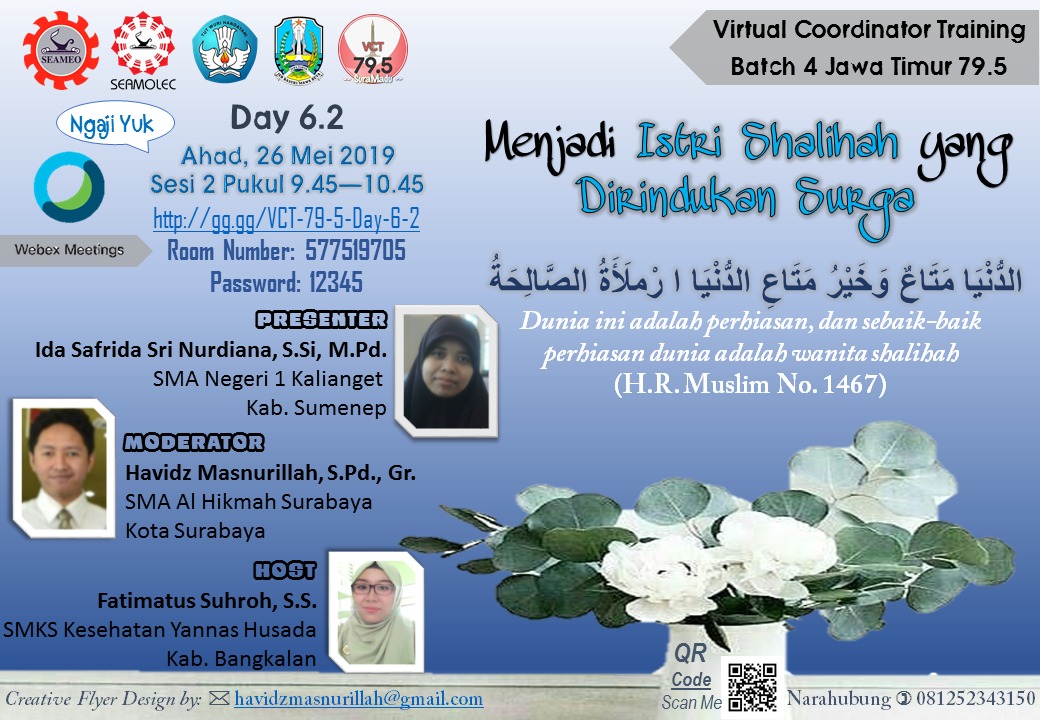
Presenter: Ida Safrida Sri
Nurdiana, S.Si,. M.Pd (SMAN 1 Kalianget)
Moderator: Havidz Masnurillah, S.Pd,.
Gr. (SMA AL-HIKMAH Surabaya)
Host: Fatimatus Suhroh,
S.S (SMKS Kesehatan Yannas Husada Bangkalan)
Menjadi
Istri Sholehah Yang Dirindukan Surga
Such is the experience of the author while
participating in Batch 4. Virtual Coordinator Training Training (VCT). A
lot of knowledge was obtained from fellow educators in East Java with various
educational backgrounds and different subjects. Changing assignments as a
presenter shared knowledge with the participants who also came from educators.
The participants who acted as Moderators and Hosts
were able to sharpen themselves in the communication and social aspects of
their active role in the online seminar.
Educators who are positioned as participants are no
less happy. This is because there is a lot of knowledge that they can find in
these activities. The knowledge that will definitely be very useful in the process
of teaching and learning activities of students in their respective schools.
Finally, the author apologizes if there is a mistake
that is said or acted on. Thank you for all the hard work of the instructors
who have shared their knowledge and also the implementing organization of the
Batch 4 Virtual Coordinator Training (VCT). May Allah SWT reciprocate your
kindness. Aamiin
* The author is an Educator in SMKS Kesehatan Yannas
Husada Bangkalan
KIND OF TEXT
These variations are known as GENRES, types of text, or kinds of text but NOT text forms. Now we will see the summary of all kids of text.
Text Types 1: NARRATIVE
Purpose:
To amuse/entertain the readers and to tell a story
Generic Structure:
1. Orientation
2. Complication
3. Resolution
4. Reorientation (optional)
Dominant Language Features:
1. Using Past Tense
2. Using action verb
3. Chronologically arranged
Purpose:
To amuse/entertain the readers and to tell a story
Generic Structure:
1. Orientation
2. Complication
3. Resolution
4. Reorientation (optional)
Dominant Language Features:
1. Using Past Tense
2. Using action verb
3. Chronologically arranged
- What is Narrative? Defintition and sample text
- Kinds of narrative story learned in high schooll
- 16 Contoh Terbaik Narrative Text Pendek
Text Types 2: RECOUNT
Purpose:
To retell something that happened in the past and to tell a series of past event
Generic Structure:
1. Orientation
2. Event(s)
3. Reorientation
Dominant Language Features:
1. Using Past Tense
2. Using action verb
3. Using adjectives
Purpose:
To retell something that happened in the past and to tell a series of past event
Generic Structure:
1. Orientation
2. Event(s)
3. Reorientation
Dominant Language Features:
1. Using Past Tense
2. Using action verb
3. Using adjectives
Narrative and recount in some ways are similar. Both are telling something in the past so narrative and recount usually apply PAST TENSE; whether Simple Past Tense, Simple Past Continuous Tense, or Past Perfect Tense. The ways narrative and recount told are in chronological order using time or place. Commonly narrative text is found in story book; myth, fable, folklore, etc while recount text is found in biography.
The thing that makes narrative and recount different is the structure in which they are constructed. Narrative uses conflicts among the participants whether natural conflict, social conflict or psychological conflict. In some ways narrative text combines all these conflicts. In the contrary, we do not find these conflicts inside recount text. Recount applies series of event as the basic structure
Recount text is used in various form. For more explanation, you can read:
- What is Recount? Definition and sample
- Past tenses used in recount text
- Kumpulan Contoh Recount Text Bahasa Inggris Terbaik
Text Types 3: DESCRIPTIVE
Purpose:
To describe a particular person, place or thing in detail.
Dominant Generic Structure:
1. Identification
2. Description
Language Features:
1. Using Simple Present Tense
2. Using action verb
3. Using adverb
4. Using special technical terms
Purpose:
To describe a particular person, place or thing in detail.
Dominant Generic Structure:
1. Identification
2. Description
Language Features:
1. Using Simple Present Tense
2. Using action verb
3. Using adverb
4. Using special technical terms
For more explanation on descriptive text, you can read:
- What is Descriptive Text? Pengertian dan contoh
- The difference between descriptive text and report text
- 9 Contoh Descriptive Text Pendek Bahasa Inggris
Text Types 4: REPORT
Purpose:
To presents information about something, as it is.
Generic Structure:
1. General classification
2. Description
Dominant Language Feature:
1. Introducing group or general aspect
2. Using conditional logical connection
3. Using Simple Present Tense
Purpose:
To presents information about something, as it is.
Generic Structure:
1. General classification
2. Description
Dominant Language Feature:
1. Introducing group or general aspect
2. Using conditional logical connection
3. Using Simple Present Tense
For more explanation on report text, you can read:
Text Types 5: EXPLANATION
Purpose:
To explain the processes involved in the formation or working of natural or socio-cultural phenomena.
Generic Structure:
1. General statement
2. Explanation
3. Closing
Dominant Language Features:
1. Using Simple Present Tense
2. Using action verbs
3. Using passive voice
4. Using noun phrase
5. Using adverbial phrase
6. Using technical terms
7. Using general and abstract noun
8. Using conjunction of time and cause-effect
Purpose:
To explain the processes involved in the formation or working of natural or socio-cultural phenomena.
Generic Structure:
1. General statement
2. Explanation
3. Closing
Dominant Language Features:
1. Using Simple Present Tense
2. Using action verbs
3. Using passive voice
4. Using noun phrase
5. Using adverbial phrase
6. Using technical terms
7. Using general and abstract noun
8. Using conjunction of time and cause-effect
For more study on explanation text, you can read:
Text Types 6: ANALYTICAL EXPOSITION
Purpose:
To reveal the readers that something is the important case
Generic Structure:
1. Thesis
2. Arguments
3. Reiteration/Conclusion
Dominant Language Features:
1. Using modals
2. Using action verbs
3. Using thinking verbs
4. Using adverbs
5. Using adjective
6. Using technical terms
7. Using general and abstract noun
8. Using connectives/transition
Purpose:
To reveal the readers that something is the important case
Generic Structure:
1. Thesis
2. Arguments
3. Reiteration/Conclusion
Dominant Language Features:
1. Using modals
2. Using action verbs
3. Using thinking verbs
4. Using adverbs
5. Using adjective
6. Using technical terms
7. Using general and abstract noun
8. Using connectives/transition
You can read more about explanation text on the following articles:
- What is Analytical Exposition? Defintition and sample
- 12 Contoh Analytical Exposition Terbaik Bahasa Inggris
Text Types 7: HORTATORY EXPOSITION
Purpose:
To persuade the readers that something should or should not be the case or be done
Generic Structure:
1. Thesis
2. Arguments
3. Recommendation
Dominant Language Features:
1. Using Simple Present Tense
2. Using modals
3. Using action verbs
4. Using thinking verbs
5. Using adverbs
6. Using adjective
7. Using technical terms
8. Using general and abstract noun
9. Using connectives/transition
Purpose:
To persuade the readers that something should or should not be the case or be done
Generic Structure:
1. Thesis
2. Arguments
3. Recommendation
Dominant Language Features:
1. Using Simple Present Tense
2. Using modals
3. Using action verbs
4. Using thinking verbs
5. Using adverbs
6. Using adjective
7. Using technical terms
8. Using general and abstract noun
9. Using connectives/transition
Articles about hortatory exposition can be found more on:
- What is Hortatory Exposition? Pengertian dan contoh
- Kumpulan Contoh Text Hortatory ExpositionTerbaik dalam Bahasa inggris
Then what is the basic difference between analytical and hortatory exposition. In simple word. Analytical is the answer of “How is/will” while hortatory is the answer of “How should”. Analytical exposition will be best to describe “How will student do for his examination? The point is the important thing to do. But for the question” How should student do for his exam?” will be good to be answered with hortatory. It is to convince that the thing should be done
Text Types 8: PROCEDURE
Purpose:
To help readers how to do or make something completely
Generic Structure:
1. Goal/Aim
2. Materials/Equipments
3. Steps/Methods
Dominant Language Features:
1. Using Simple Present Tense
2. Using Imperatives sentence
3. Using adverb
4. Using technical terms
Purpose:
To help readers how to do or make something completely
Generic Structure:
1. Goal/Aim
2. Materials/Equipments
3. Steps/Methods
Dominant Language Features:
1. Using Simple Present Tense
2. Using Imperatives sentence
3. Using adverb
4. Using technical terms
If you like to read more about procedure text, you can read the following articles:
Text tyeps 9: DISCUSSION
Purpose:
To present information and opinions about issues in more one side of an issue (‘For/Pros’ and ‘Against/Cons’)
Generic Structure:
1. Issue
2. Arguments for and against
3. Conclusion
Dominant Language Features:
1. Using Simple Present Tense
2. Use of relating verb/to be
3. Using thinking verb
4. Using general and abstract noun
5. Using conjunction/transition
6. Using modality
7. Using adverb of manner
Purpose:
To present information and opinions about issues in more one side of an issue (‘For/Pros’ and ‘Against/Cons’)
Generic Structure:
1. Issue
2. Arguments for and against
3. Conclusion
Dominant Language Features:
1. Using Simple Present Tense
2. Use of relating verb/to be
3. Using thinking verb
4. Using general and abstract noun
5. Using conjunction/transition
6. Using modality
7. Using adverb of manner
Explanations more on discussion text can be read on:
- What is Discussion? Pengertian dan contoh
- Kumpulan Contoh Discussion Text Terbaik dalam Bahasa Inggris
Text Types 10: REVIEW
Purpose:
To critique or evaluate an art work or event for a public audience
Dominant Generic Structure:
1. Orientation
2. Evaluation
3. Interpretative Recount
4. Evaluation
5. Evaluative Summation
Dominant Language Features:
1. Focus on specific participants
2. Using adjectives
3. Using long and complex clauses
4. Using metaphor
Purpose:
To critique or evaluate an art work or event for a public audience
Dominant Generic Structure:
1. Orientation
2. Evaluation
3. Interpretative Recount
4. Evaluation
5. Evaluative Summation
Dominant Language Features:
1. Focus on specific participants
2. Using adjectives
3. Using long and complex clauses
4. Using metaphor
Review text can be found more on:
Text Types 11: ANECDOTE
Purpose:
To share with others an account of an unusual or amusing incident
Generic Structure:
1. Abstract
2. Orientation
3. Crisis
4. Reaction
5. Coda.
Dominant Language Features:
1. Using exclamations, rhetorical question or intensifiers
2. Using material process
3. Using temporal conjunctions
Purpose:
To share with others an account of an unusual or amusing incident
Generic Structure:
1. Abstract
2. Orientation
3. Crisis
4. Reaction
5. Coda.
Dominant Language Features:
1. Using exclamations, rhetorical question or intensifiers
2. Using material process
3. Using temporal conjunctions
Finding more on anecdote text, you can read:
- What is Anecdote? Pengertian dan contoh
- The Best Example of Anecdote Text – From Bankrupt Candle to Best Seller Soap
Text Types 12: SPOOF
Purpose:
To tell an event with a humorous twist and entertain the readers
Generic Structure:
1. Orientation
2. Event(s)
3. Twist
Dominant Language Features:
1. Using Past Tense
2. Using action verb
3. Using adverb
4. Chronologically arranged
Purpose:
To tell an event with a humorous twist and entertain the readers
Generic Structure:
1. Orientation
2. Event(s)
3. Twist
Dominant Language Features:
1. Using Past Tense
2. Using action verb
3. Using adverb
4. Chronologically arranged
Read more about spoof text on the following articles:
- What is Spoof? Pengertian dan contoh
- Kinds of twist in spoof text ending
- 12 Contoh Spoof Text Terbaik dengan TWIST Berbeda
Text Tyeps 13: NEWS ITEM
Purpose:
To inform readers about events of the day which are considered newsworthy or important
Dominant Generic Structure:
1. Newsworthy event
2. Background events
3. Sources
Dominant Language Features:
1. Short, telegraphic information about story captured in headline
2. Using action verbs
3. Using saying verbs
4. Using adverbs : time, place and manner
Purpose:
To inform readers about events of the day which are considered newsworthy or important
Dominant Generic Structure:
1. Newsworthy event
2. Background events
3. Sources
Dominant Language Features:
1. Short, telegraphic information about story captured in headline
2. Using action verbs
3. Using saying verbs
4. Using adverbs : time, place and manner
If need more explanation on news item text, you can read:
This is the summary of all English text types learned in high schools. Remember that it is impossible to build a long text in English only through one single types. In functional writing, a text will be structured with a combination of two or more genres to achieve the writer’s goal.
SUBJUNCTIVE
Pengertian Subjunctive
Subjunctive adalah kata kerja yang digunakan untuk membayangkan akibat dari sesuatu yang tidak ada atau tidak terjadi, yang dapat berupa wish (harapan), requirements (kebutuhan), dan suggestion(saran). Atau dengan kata lain, makna kalimat subjunctive ini selalu berlawanan dengan kenyataan atau fakta.
Kata-kata yang digunakan dalam subjunctive adalah “wish”(menginginkan/ mengharapkan), “as if/ as though” (seolah-olah), “would rather” (lebih suka), “if only” (seandainya/ jika saja).
Fungsi Subjunctive
As if/ as though digunakan untuk menyatakan keadaan yang tidak benar kenyataan atau faktanya.
|
Wish, would rather, dan if only digunakan untuk menyatakan suatu harapan atau keinginan.
|
Rumus Penggunaan Subjunctive
1. Future Subjunctive
Future Subjunctive digunakan sebagai kalimat pengandaian yang mengacu pada masa yang akan datang, jadi faktanya juga dalam bentuk Simple Future Tense.
Wish
|
Subject (1) + wish + Subject (2) + Could / Would + Verb 1
|
Contoh:
I wish you would come to the party tonight.
(Artinya: Saya berharap kamu akan datang ke pesta nanti malam.)
(Faktanya: He will not come to the party tonight)
CATATAN
Walaupun jarang digunakan, tetapi Future Subjunctive terkadang masih sering kita jumpai, jadi lebih baik kita mengenalinya juga. Sebagai gantinya bisa menggunakan Present Subjunctive.
2. Present Subjunctive
Present Subjunctive digunakan sebagai kalimat pengandaian yang mengacu pada masa sekarang, jadi faktanya juga dalam bentuk Simple Present Tense.
Wish
|
Subject (1) + wish + Subject (2) + Verb 2 / were
|
As if /As though
|
Subject (1) + Verb 1 + as if + Subject (2) + Verb2 / were
|
Would rather
|
Subject (1) + would rather + Subject (2) + Verb 2 / were
|
If only
|
If only + Subject + Verb 2
|
CATATAN
Pada bentuk Present Subjunctive, kata kerja yang digunakan adalah bentuk ke-2 (VERB 2), dan jika harus menggunakan to be, harus menggunakan “were” untuk semua jenis Subject.
Contoh:
I wish you visited me.
(Artinya: Saya berharap kamu mengunjungi saya.)
(Faktanya: You don’t visit me.)
The girl dresses as if it were summer now.
(Artinya: Perempuan itu berpakaian seolah-olah sekarang musim panas.)
(Faktanya: it is not summer now.)
Shelly would rather he told the truth.
(Artinya: Shelly lebih suka dia mengatakan yang sebenarnya.)
(Faktanya: He doesn’t tell the truth.)
If only she knew.
(Artinya: Seandainya dia tau.)
(Faktanya: She doesn’t know.)
3. Past Subjunctive
Past Subjunctive digunakan sebagai kalimat pengandaian yang mengacu pada masa lampau, jadi faktanya juga dalam bentuk Simple Past Tense.
Wish
|
Subject (1) + wished + Subject (2) + Had + Verb 3 / been
|
As if /As though
|
Subject (1) + Verb 2 + as if + Had + Verb 3 / been
|
Would rather
|
Subject (1) + would rather + Subject 2 + Had + Verb 3 / been
|
If only
|
If only + Subject + Had + Verb 3 / been
|
Contoh:
She wished (that) she had had more time last night.
(Artinya: Dia berharap bahwa dia punya waktu lebih kemarin malam.)
(Faktanya: She didn’t have more time last night.)
Jeff looked as though he had seen a ghost.
(Artinya: Jeff terlihat seolah-olah dia telah melihat hantu.)
(Faktanya: He didn’t see a ghost.)
I would rather he had been here.
(Artinya: Saya lebih suka dia sudah berada disini.)
(Faktanya: He was not here.)
If only Rachel had not been at home last night
(Artinya: Seandainya Rachel sudah tidak ada di rumah kemarin malam.)
(Faktanya: Rachel was at home last night.)
Langganan:
Postingan
(
Atom
)